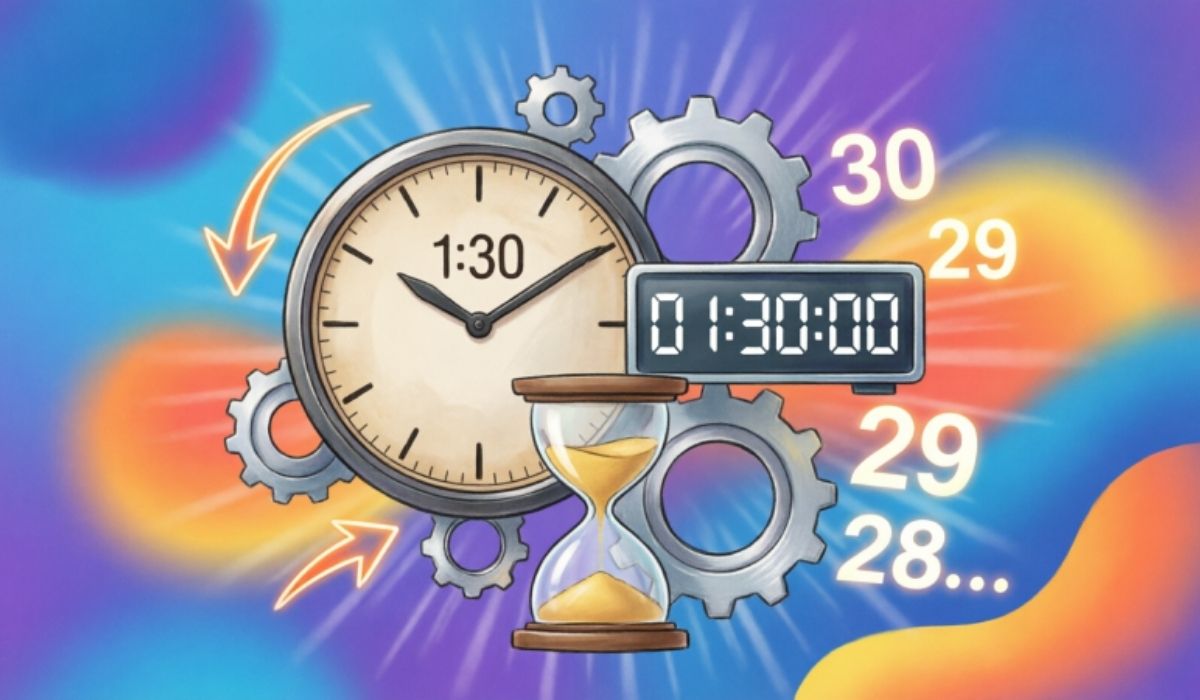
How Long Until 1:30? A Simple Guide to Calculating Time Countdowns
Written by a content strategist who’s tired of clunky time calculators. Quick read, real answers.
You glanced at the clock, saw a meeting or appointment set for 1:30, and now you’re doing that mental math thing everyone does — squinting at the minute hand and trying to figure out how much longer you have to wait. Whether it’s 1:30 PM or 1:30 AM, the question “how long until 1:30” comes up more often than you’d think, and the answer depends entirely on what time it is right now.
This guide walks you through exactly how to calculate it yourself, in your head or on paper, with real examples, tables, and a few shortcuts that make the math painless.
Quick Answer: How to Figure Out How Long Until 1:30
To find how long until 1:30, subtract your current time from 1:30. If the current time is earlier than 1:30 in the same 12-hour block, just subtract directly. If it’s later, you’ll need to add 12 hours (or count forward to the next day) before subtracting. There’s no universal number — the countdown changes minute by minute — but the method never changes.
Here’s the general formula:
Time Until 1:30 = 1:30 − Current Time
If the result is negative, add 12 hours (for same AM/PM cycle) or 24 hours (if you’re counting to the next day’s 1:30).
ALSO MORE:https://deepspires.com/how-long-until-1230/
Why This Question Trips People Up
It sounds simple, but a few things make “how long until 1:30” more confusing than it should be:
- AM vs PM ambiguity. Someone says “see you at 1:30” and doesn’t specify — is it after lunch or after midnight?
- Crossing the hour mark. Subtracting minutes when the current time has a smaller minute value than 30 requires borrowing, which throws people off.
- 12-hour vs 24-hour clocks. If you’re working with military time (13:30), the mental math shifts slightly.
- Time zone confusion. If you’re coordinating with someone in another region, “1:30” might mean something completely different to them.
Once you separate these variables, the calculation becomes mechanical.
Step-by-Step: How to Calculate Time Until 1:30
Let’s break this into a clean process you can repeat every time.
Step 1: Confirm AM or PM
Before anything else, lock down whether you’re counting to 1:30 AM or 1:30 PM. This single detail changes your entire calculation.
Step 2: Note the Current Time
Look at your current time in the same format (12-hour or 24-hour). Write it down if it helps — for example, “It’s currently 11:45 AM.”
Step 3: Subtract Hours First
Subtract the current hour from the target hour (1). If the target hour is smaller, add 12 to it temporarily.
Step 4: Subtract Minutes
Subtract the current minute from 30. If the current minute is greater than 30, borrow an hour (subtract 1 from your hour total) and add 60 to the minute side before subtracting.
Step 5: Combine the Result
Add the hour and minute differences together for your final countdown.
Worked Example
Let’s say it’s currently 11:45 AM, and you want to know how long until 1:30 PM.
- Hours: 1 PM is “13” in 24-hour terms. 13 − 11 = 2 hours.
- Minutes: 30 − 45 is negative, so borrow: 30 + 60 = 90, then 90 − 45 = 45 minutes, and reduce the hour count by 1.
- Final result: 1 hour and 45 minutes.
That matches reality — from 11:45 AM to 1:30 PM is exactly 1 hour 45 minutes.
Example Countdown Table (Same-Day, PM Target)
Here’s a table showing how long until 1:30 PM from various starting points during the day.
| Current Time | Time Until 1:30 PM |
|---|---|
| 8:00 AM | 5 hours 30 minutes |
| 9:15 AM | 4 hours 15 minutes |
| 10:30 AM | 3 hours 0 minutes |
| 11:00 AM | 2 hours 30 minutes |
| 12:00 PM | 1 hour 30 minutes |
| 1:00 PM | 30 minutes |
| 1:15 PM | 15 minutes |
| 1:29 PM | 1 minute |
Example Countdown Table (Same-Day, AM Target)
If you’re counting toward 1:30 AM instead — say, tracking how long until midnight rolls into the early morning — the table looks like this:
| Current Time | Time Until 1:30 AM |
|---|---|
| 6:00 PM | 7 hours 30 minutes |
| 8:45 PM | 4 hours 45 minutes |
| 10:00 PM | 3 hours 30 minutes |
| 11:30 PM | 2 hours 0 minutes |
| 12:15 AM | 1 hour 15 minutes |
| 1:00 AM | 30 minutes |
| 1:20 AM | 10 minutes |
Converting the Countdown Into Different Units
Sometimes minutes and hours aren’t the format you need. Maybe you want seconds for a script, or a decimal hour value for a timesheet. Here’s a quick conversion reference based on a 1 hour 45 minute countdown (our earlier example):
| Format | Value |
|---|---|
| Hours & Minutes | 1 hr 45 min |
| Total Minutes | 105 minutes |
| Total Seconds | 6,300 seconds |
| Decimal Hours | 1.75 hours |
To convert hours and minutes into decimal hours, divide the minutes by 60 and add that to the whole hour: 45 ÷ 60 = 0.75, so 1 hour 45 minutes becomes 1.75 hours.
Real-World Scenarios Where This Matters
Scheduling a Meeting
You’re wrapping up a task at 12:50 PM and your next meeting starts at 1:30 PM. That gives you 40 minutes — enough time for a quick lunch, but not enough to start something new.
Catching a Flight or Train
Boarding closes at 1:30 PM, and it’s currently 12:15 PM. You’ve got 1 hour 15 minutes, which sounds like plenty until you factor in security lines and walking distance to the gate.
Cooking or Baking Timers
If a recipe needs to come out of the oven at 1:30 and you put it in at 12:00, you’re working with a 1.5-hour window — useful when you’re also prepping side dishes on a separate timeline.
Late-Night Countdown to 1:30 AM
If you’re pulling an all-nighter and want to know how long until 1:30 AM from, say, 10:40 PM, that’s 2 hours 50 minutes — a good mental checkpoint for pacing your work.
Common Mistakes People Make
- Forgetting to check AM/PM. This is the single biggest source of wrong answers. A countdown to 1:30 AM versus 1:30 PM can differ by up to 12 hours.
- Subtracting minutes without borrowing. If your current minute value is higher than 30, you can’t just subtract straight across — you’ll get a negative number and a wrong answer.
- Ignoring the date change. If it’s already past 1:30 PM and you’re asking about 1:30 AM the next day, you need to count through midnight, not just subtract within the same day.
- Mixing 12-hour and 24-hour formats. If your current time is in 24-hour format (like 14:20) but you’re comparing it to “1:30” without specifying AM/PM, you’ll misjudge the gap.
- Rounding too early. Rounding 1 hour 44 minutes to “about 2 hours” might be fine for casual planning, but it throws off precise scheduling.
Why People Search “How Long Until 1:30”
This isn’t just idle curiosity. People search this phrase because they’re:
- Counting down to an appointment, meeting, or class.
- Timing a food or cooking task with a specific end point.
- Trying to figure out how much of their workday or shift is left.
- Coordinating a call or event across time zones and doing quick mental checks.
- Setting an alarm or reminder and want to sanity-check how much time remains.
The phrase itself is a stand-in for a bigger need: quick, reliable time math without opening a calculator app or doing long division on paper.
Related Calculations Worth Knowing
Once you’ve got the method for 1:30 down, the same logic applies to any target time. Here are a few related countdown questions people often search alongside this one:
- How long until 2:00
- How long until noon
- How long until midnight
- How long until 5:00 PM (common for end-of-workday countdowns)
- How many hours between two given times
The core formula stays identical — subtract current time from target time, borrow when needed, and double-check AM/PM.
Conclusion
Figuring out how long until 1:30 isn’t complicated once you break it into hours and minutes separately, confirm AM or PM, and borrow correctly when your current minute value is higher than 30. Use the tables above as a quick reference, or run through the five-step method whenever a new starting time pops up. Either way, you’ll never have to squint at a clock and guess again.
FAQs
How long until 1:30 PM from right now?
It depends entirely on your current time. Subtract your current hour and minute from 1:30 PM using the borrowing method described above, or check the reference table for common starting points.
How do I calculate how long until 1:30 AM without a calculator?
Convert both times to 24-hour format if needed, subtract the current hour from 13 (or 1, depending on whether you’ve crossed midnight), then subtract the minutes, borrowing an hour if your current minute is above 30.
Is there a difference between counting to 1:30 AM and 1:30 PM?
Yes. They’re 12 hours apart on a standard clock, so mixing them up can throw your countdown off by half a day. Always confirm which one you mean before calculating.
What’s the fastest way to check how long until 1:30 without doing math?
Set a phone alarm or countdown timer for 1:30 and let your device handle the calculation instantly — useful when you’re mid-task and don’t want to interrupt your flow to do mental math.
How many minutes are there between 12:00 PM and 1:30 PM?
Exactly 90 minutes, or 1 hour and 30 minutes. This is one of the most commonly searched countdown windows since it spans a typical lunch break.

James Michael is a faith writer with 5+ years of experience, sharing inspiring blessings, heartfelt prayers, and uplifting Christian devotionals worldwide.