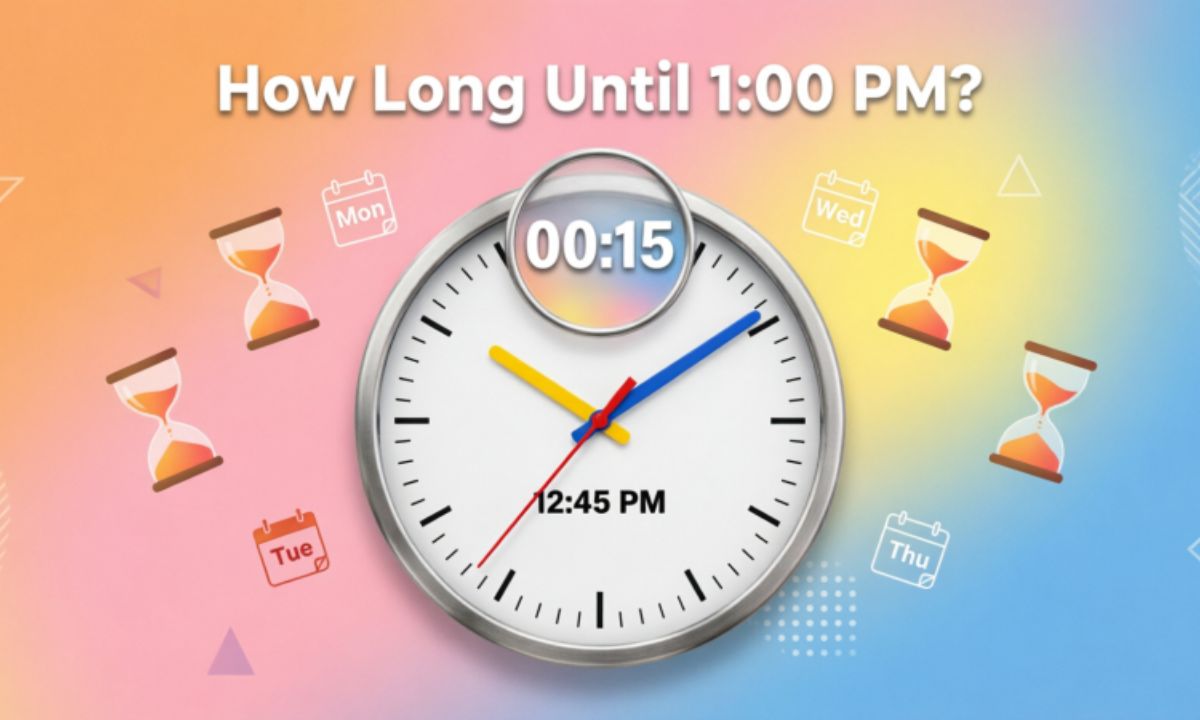
How Long Until 1:00 PM? A Quick Guide to Counting Down the Clock
Written by a productivity and time-management content writer | 8 min read
You glanced at the clock, saw it wasn’t quite noon yet, and now you’re wondering exactly how many hours and minutes stand between you and 1:00 PM. Maybe you’ve got a lunch meeting. Maybe you’re counting down to your shift ending, a flight boarding, or just the moment you finally get to eat. Whatever the reason, figuring out “how long until 1:00 PM” is one of those small calculations that feels harder than it should be when you’re staring at a clock mid-task.
This guide walks you through exactly how to calculate the time remaining until 1:00 PM from any starting point, gives you ready-made reference tables, and clears up the small mistakes people make when doing this math in their heads.
Quick Answer
The time remaining until 1:00 PM depends entirely on your current time. Here’s the simple formula:
Hours and minutes until 1:00 PM = 13:00 (in 24-hour format) minus your current time.
For example:
- If it’s 11:00 AM, you have 2 hours until 1:00 PM.
- If it’s 12:30 PM, you have 30 minutes until 1:00 PM.
- If it’s 9:15 AM, you have 3 hours and 45 minutes until 1:00 PM.
If your current time is already past 1:00 PM, you’re not counting down anymore — you’d be calculating how long until 1:00 PM tomorrow, which means adding the remaining hours of today plus 13 hours into the next day.
READ ALSO”How Long Until 3:45 AM?
Why People Search “How Long Until 1:00 PM”
This search feels oddly specific, but it comes up constantly, and usually for practical reasons:
- Work shifts — Many jobs run on a 9-to-1 or 8-to-1 schedule, so 1:00 PM marks a break, a shift change, or the end of the morning block.
- School and university schedules — Classes, lunch periods, and exam start times often land right around 1:00 PM.
- Meetings and appointments — Doctor’s appointments, calls, and interviews scheduled for 1:00 PM leave people mentally counting down.
- Fasting and diet tracking — Intermittent fasters frequently break their fast at 1:00 PM, so the countdown matters for meal timing.
- Travel — Flight boarding, train departures, or hotel check-in/check-out set for 1:00 PM.
- Deadlines — Submission windows, online sales, or ticket releases that open or close at 1:00 PM sharp.
Basically, 1:00 PM sits right in that midday sweet spot where a lot of daily life pivots, so it’s a natural reference point people build their day around.
Step-by-Step: How to Calculate Time Until 1:00 PM
Here’s the manual method, broken into simple steps you can do in your head or on paper.
Step 1: Convert 1:00 PM to 24-hour time
1:00 PM = 13:00. Keeping this in 24-hour format removes the AM/PM confusion that trips people up.
Step 2: Convert your current time to 24-hour format (if it’s AM, it stays the same)
- 9:00 AM = 09:00
- 11:45 AM = 11:45
- 12:20 PM = 12:20 (noon hour stays as 12 in 24-hour time)
Step 3: Subtract your current time from 13:00
Do this in two parts — hours first, then minutes.
Example: Current time is 10:20 AM (10:20)
- Hours: 13 − 10 = 3
- Minutes: 00 − 20 = -20, so borrow an hour: 3 becomes 2, and 60 − 20 = 40 minutes
- Result: 2 hours and 40 minutes until 1:00 PM
Step 4: Double-check with a simpler shortcut
If the math feels fiddly, break it into two smaller subtractions:
- Calculate minutes until the next full hour.
- Add the remaining full hours until 1:00 PM.
Example: Current time is 10:20 AM
- Minutes until 11:00 AM = 40 minutes
- Full hours from 11:00 AM to 1:00 PM = 2 hours
- Total = 2 hours 40 minutes — same answer, easier to picture.
Reference Table: Time Remaining Until 1:00 PM
Use this table to skip the math entirely if your current time falls close to one of these marks.
| Current Time | Time Until 1:00 PM |
|---|---|
| 8:00 AM | 5 hours |
| 8:30 AM | 4 hours 30 minutes |
| 9:00 AM | 4 hours |
| 9:30 AM | 3 hours 30 minutes |
| 10:00 AM | 3 hours |
| 10:15 AM | 2 hours 45 minutes |
| 10:30 AM | 2 hours 30 minutes |
| 11:00 AM | 2 hours |
| 11:15 AM | 1 hour 45 minutes |
| 11:30 AM | 1 hour 30 minutes |
| 11:45 AM | 1 hour 15 minutes |
| 12:00 PM (noon) | 1 hour |
| 12:15 PM | 45 minutes |
| 12:30 PM | 30 minutes |
| 12:45 PM | 15 minutes |
| 12:55 PM | 5 minutes |
| 1:00 PM | 0 minutes (it’s here) |
What If It’s Already Past 1:00 PM?
If you’re checking this after 1:00 PM has already passed, you’re really asking “how long until 1:00 PM tomorrow.” Here’s how that works:
Formula: (Hours left until midnight) + 13 hours
| Current Time | Time Until 1:00 PM (Next Day) |
|---|---|
| 2:00 PM | 23 hours |
| 5:00 PM | 20 hours |
| 8:00 PM | 17 hours |
| 10:00 PM | 15 hours |
| 11:59 PM | 13 hours 1 minute |
This trips people up because they forget 1:00 PM isn’t a “once a day forever” event unless you specify which day — the clock resets, but your countdown has to account for the full loop back around.
Real-World Application Scenarios
Let’s put the formula to work in a few everyday situations.
Scenario 1: Lunch meeting prep It’s 11:40 AM and your meeting starts at 1:00 PM. That’s 1 hour and 20 minutes — enough time to finish your current task, grab a coffee, and review your notes without rushing.
Scenario 2: Breaking an intermittent fast Your eating window opens at 1:00 PM. It’s currently 9:10 AM. That leaves 3 hours and 50 minutes, roughly four hours, before you can eat.
Scenario 3: Flight boarding Boarding starts at 1:00 PM and it’s 12:05 PM. You’ve got 55 minutes — probably just enough time to grab a snack near the gate, but not enough to wander the terminal.
Scenario 4: End of a work shift Your shift ends at 1:00 PM. It’s currently 7:30 AM. That’s a 5-hour-and-30-minute stretch left on the clock.
Common Mistakes and Misconceptions
A few small errors show up again and again when people calculate time differences manually:
- Mixing up AM and PM. Forgetting whether it’s 1:00 AM or 1:00 PM changes the entire calculation. Always double-check which “1:00” you mean.
- Miscounting the noon hour. In 24-hour time, 12:00 PM stays as “12,” not “0” or “24” — a common slip-up that throws off subtraction.
- Forgetting to borrow minutes. When subtracting times, if the minutes column goes negative, you need to borrow an hour (60 minutes), just like carrying over in regular subtraction.
- Ignoring time zones. If you’re coordinating with someone in another region, “1:00 PM” means something different depending on whose clock you’re using. Always clarify which time zone applies.
- Assuming 1:00 PM only happens once. As shown above, if the time has already passed, you’re counting toward tomorrow’s 1:00 PM, not today’s.
Related Calculations and Topics
Once you’ve got the hang of counting down to 1:00 PM, the same logic applies to any target time. A few related searches and calculations worth knowing:
- How long until 5:00 PM (end of a standard workday)
- How long until midnight
- How many hours between two given times
- Countdown to a specific date and time (for deadlines or events)
- Converting between 12-hour and 24-hour time formats
- Time zone conversion between two cities
All of these use the same core subtraction principle — convert to a consistent time format, subtract, and adjust for AM/PM or day rollovers as needed.
Conclusion
Figuring out how long until 1:00 PM really comes down to one simple subtraction: take 13:00 in 24-hour format and subtract your current time. Whether you’re timing a lunch break, a fasting window, a flight, or a deadline, the math stays the same, and the reference tables above should save you the mental effort next time you need a quick answer. Once this formula clicks, you can apply it to any time of day, not just 1:00 PM.
Frequently Asked Questions
How do I calculate how long until 1:00 PM from my current time?
Convert 1:00 PM to 24-hour format (13:00), convert your current time the same way, then subtract. If the minutes go negative, borrow an hour from the hours column.
Is 1:00 PM the same as 13:00?
Yes. 1:00 PM in standard 12-hour time equals 13:00 in 24-hour (military) time. They refer to the exact same moment.
What if it’s already past 1:00 PM today?
Then you’re calculating time until 1:00 PM tomorrow. Add the hours remaining until midnight to 13 hours to get your total countdown.
Does the countdown change depending on time zones?
Yes. “1:00 PM” refers to a specific moment only within one time zone. If you’re coordinating across regions, confirm whose local time the 1:00 PM refers to before calculating.
What’s an easy way to calculate this without doing math?
Break it into two smaller steps: first find how many minutes remain until the next full hour, then count the full hours from there up to 1:00 PM, and add the two together.

James Michael is a faith writer with 5+ years of experience, sharing inspiring blessings, heartfelt prayers, and uplifting Christian devotionals worldwide.